
Showing posts with label Christian Life. Show all posts
Showing posts with label Christian Life. Show all posts
Tuesday, March 31, 2026
Old Holiness Writings


Thursday, March 05, 2026
O God, Please Save Me from Myself

Wednesday, February 04, 2026
2026 Goals/Resolutions--Number 4

Another thing that I started doing was around the beginning of December, I would start mapping out a list of sorts to sort of move me in a direction to accomplish some goals. I can remember reading Stephen Covey’s books about the seven habits of highly effective people and what he later wrote about—the eighth habit. Other time management authors like David Allen, Peter Drucker, Brian Tracy, Ken Blanchard, Spencer Johnson, and Jim Collins were books that I found myself tracking through. Somewhere along the way I picked up the idea that however you spend your time is how you spend your life. I know that might not be so profound, but its simplicity makes it worth digging into.
Wednesday, January 28, 2026
Lessons from Pilgrim's Progress--Vanity Fair & Its Challenge to Us in 2026

As I have written several times, I am indebted to Pastor John Harrell who was the long-time pastor of the Bridge City UPC in Bridge City, Texas who encouraged me to read it. I can remember the copy that I bought in a Family Christian bookstore in Dothan. It was The Pilgrim’s Progress in Modern English published by Bridge-Logos Publishers. It was a paperback copy that weathered multiple backpack journeys with me to and from Flowers Hospital when I was still working full-time in one of the IR cath labs. I look at the copy now after 25 years and the highlights and marginal notes serve almost as landmarks of a spiritual journey moving on toward the Celestial City. If you have read it, some of this may be a bit redundant to you, however, I am going to focus on some points that brings in and around the vicious town of Vanity Fair.
Thursday, January 22, 2026
Book Recommendation--Stockholm Syndrome Christianity (Why Christian Leaders are Failing--and What We Can Do About It)--John G. West

Then I started reading the westerns that were written by Louis L’Amour and Zane Grey which led to Peter McCurtin and his Sundance series. As I got older, I found Stephen Ambrose (recommended to me by Harold Hoffman) and read Undaunted Courage about Lewis and Clark and their expedition. Then I started working through his books on World War II and that opened more books about the great war in the European theater. Biographies by McCollough, Meachum, Chernow, and others were another avenue that I went down.
Mixed in was another writer that I found about the time I started in RN school whose books captivated me for more than a decade—Robin Cook! He has written more than 40 books, and I have read at least 35 of them, some of them multiple times. Somewhere along the way I accidentally found A. J. Cronin whose writing, even to this day I find incredibly intriguing especially the two that I have read several times, The Citadel and The Keys to the Kingdom. Another similar incidental find is The Lords of Discipline and The Great Santini by Pat Conroy, which pushed me to read all his other books—deep, melancholy, and provoking characters and twisting plots that have stayed with me for the long years since I have read any of his books. I could go on and on about books and authors but that is not what this blog is supposed to be about—it is a book recommendation—so I shall commence with that task.
Saturday, January 17, 2026
My Poor Blog!
January 17,
2026

It has been ages since I have written anything besides
sermon notes and Bible studies that primarily are for where I pastor in Dothan,
Alabama. On this rainy, cold Saturday
night, once again I am in my study at the Pentecostals of Dothan. It is much larger and has a whole lot more
volumes in my library than it did twenty years ago. Twenty years ago, I was literally working out
of a small room that had become a cleaning closet for the old fellowship hall. In December 2005, I had made the transition
from working full-time in an Interventional Radiology Cath lab as an RN to a
very part-time basis that I would continue until the fall of 2014. So, I had gone from a high-tech medical
procedure lab to a dusty, dilapidated “broom closet” and that is where the
Barnabas Blog started. The space was 12
feet by 16 feet with a noisy window unit that cranked out very cold air but also
sprayed mildew all over creation as well.
In those simple surroundings, I wrote and prayed, wrote some more and
prayed some more, and wrote even more and prayed even more. Prayer is far more important than writing,
however prayer will set your mind and pen on fire while you are writing. So, I wrote!
Honestly, I had no idea how many people would come to read the Barnabas
Blog in that first decade. It never crossed
my mind that it would inspire, convict, encourage, and in some cases
aggravate. So many people came up to me
at various conferences and introduced themselves as readers, to the degree that
it was amazing. Once there was a time
when I got hemmed in by a couple of preachers who felt like I had no business
writing content like I did. I look back
at those days and ask myself what I asked just before I started this blog post:
Why did you quit writing?!
Friday, January 08, 2021
Why You Should Have a Prayer Bible

I think that most of the people who read this blog are familiar with the Pentecostals of Alexandria in Louisiana. It is led by Pastor Anthony Mangun who has been there since the early ‘80’s and prior to that, his father, Bishop G. A. Mangun was the pastor. One of the most important ministries of that church is the 24-hour prayer chain that has been ongoing since 1968 or so. It is designed to follow 3-hour shifts. A number of years ago at Because of the Times, I saw the signup sheets that are used. They have at least three people present and praying around the clock. Over the years, I have dropped in to pray at POA several times at varying times of the day when I was passing through the city. I have been in there in the late evening and also in the early morning hours and there is always someone in the prayer area. The prayer rooms used to be located in the G. A. Mangun center, but they have been moved now to the newer building that houses the sanctuary. Two prayer areas are located to the sides of the sanctuary and in one of them is a layout of the Tabernacle where you are encouraged to pray through it as a patterned prayer. They also have a table that has a large glass container to place written prayer needs in it. Various prayer guides are also available and there are also framed pictures on the walls that are themed toward prayer. It was during one of those times that I had slipped in to pray probably in the early ‘90’s that I saw several of the older saints who had open Bibles laying on the prayer altars that were in the room. So that I would not be a nosy soul, I occasionally would slip a furtive glance over at them to see what they were doing with the Bibles. After watching and listening to them, I realized they were praying through the Psalms. That was the first time that I had observed this practice taking place and struck me in a very powerful way. Some time passed before I started practicing it as well, greatly to my benefit. I will never ever forget one Saturday night at our church that I made an effort pray the Word. It was pushing midnight and I was alone in our old church on the front row sitting under one of the sidelights which barely illuminated the old sanctuary. The following Scriptures were the ones I started praying through:

1 Timothy 6:11–16 (KJV) 11 But thou, O man of God, flee these things; and follow after righteousness, godliness, faith, love, patience, meekness. 12 Fight the good fight of faith, lay hold on eternal life, whereunto thou art also called, and hast professed a good profession before many witnesses. 13 I give thee charge in the sight of God, who quickeneth all things, and before Christ Jesus, who before Pontius Pilate witnessed a good confession; 14 That thou keep this commandment without spot, unrebukeable, until the appearing of our Lord Jesus Christ: 15 Which in his times he shall shew, who is the blessed and only Potentate, the King of kings, and Lord of lords; 16 Who only hath immortality, dwelling in the light which no man can approach unto; whom no man hath seen, nor can see: to whom be honour and power everlasting. Amen.

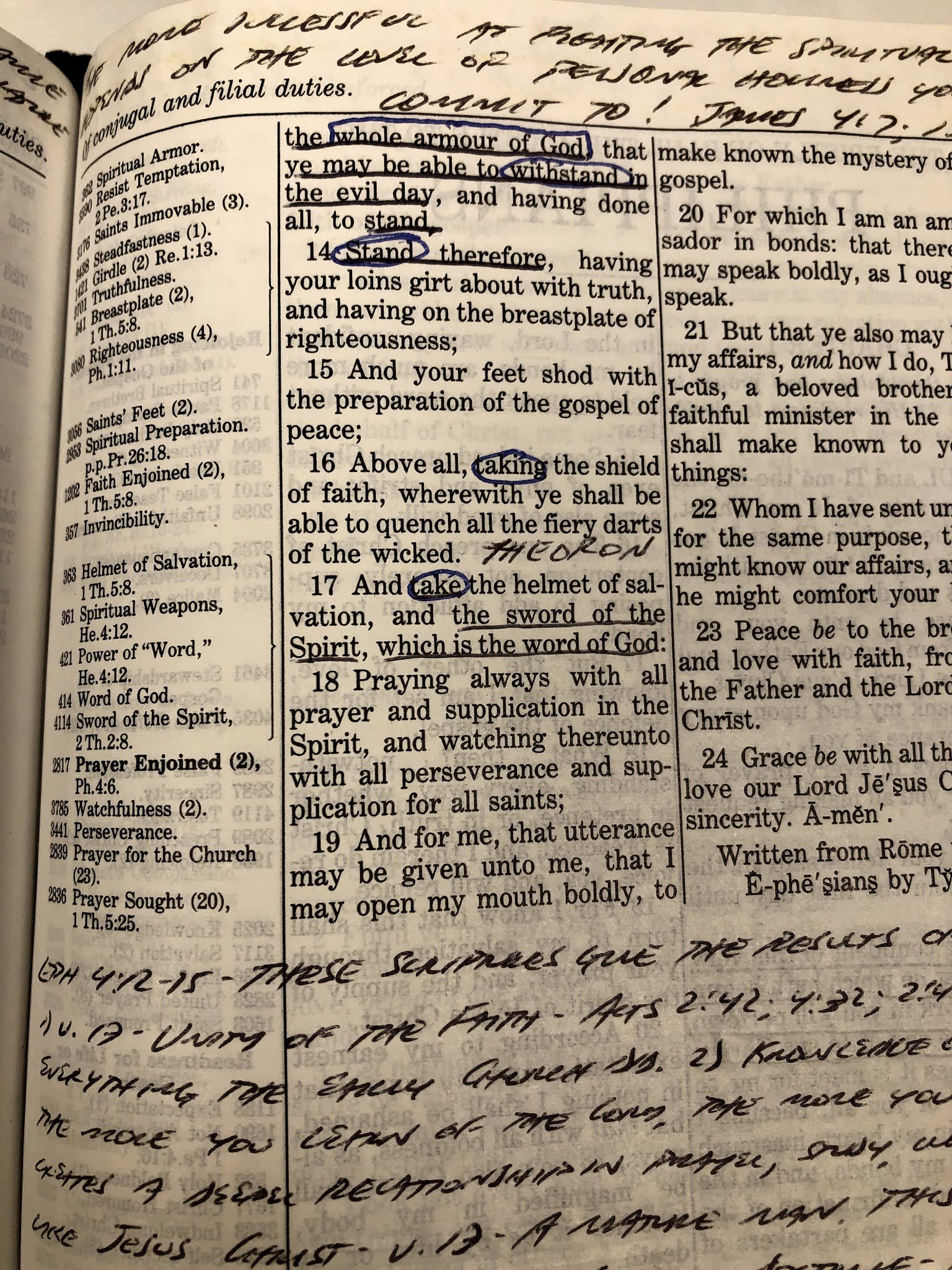
What are some things you should mark up in a “prayer” Bible? If you have a personal library either physical or digital, make your books work for you. Look at your books as if they are tools, or even soldiers that are under your command, and get the most out of them. Herbert Lockyer’s All the Prayers in the Bible, E. M. Bounds single volume works on prayer, Andrew Murray’s With Christ in the School of Prayer, Dr. Jim Rosscup’s four volumes on prayer (given to me by Pastor Tony Mansinho) of all the prayers in the OT/NT, and John Eckhardt’s prayer books are all very good tools to push you into a direction of biblically driven praying. Read through those prayers and then outline them in your Bible. On another practical tip as well, use Flair marker pens and take the colors and use them for a variety of themes. However, to keep track of your colors, mark them in the front of the Bible so you don’t just begin to haphazardly mismark your Bible. Some of the different colors I use are for doctrinal content, holiness themes, spiritual warfare, and the kingdom of God. One of the mistakes I made early on was not have a precise color system. What the color choices do is help you to look through a “prayer” Bible and pick up on particular themes of prayer that you need to give yourself to: intercession, supplication, repentance, empowerment, enlightenment, and discernment.

Another one of the things that praying the Scriptures will do is force
you to look at verses in their proper context.
For instance, there are four prayers that Paul prayed as given in his
prison epistles (Ephesians, Philippians, and Colossians) that confronted some
faulty understanding that I had of how God operates in the churches. Paul prayed for doctrinal understanding, a
proper foundation in Christian living, to be filled with holiness, and
spiritual understanding. When you began
to pray for this in your local church especially if you are a pastor or in some
role as a spiritual leader, it can really move you to a place of clarity as to what
we should be praying for. In my
thoughts, perhaps the majority of our prayers are focused more on material and
physical needs than for the spiritual work both individually and corporately
for the kingdom of God. There is also a
wealth of instruction that can be mined out by looking at what is commonly referred
to as the Lord’s prayer in the Sermon on the Mount (Matthew 6) which is really
the disciple’s prayer. If you truly want
to look at the Lord’s prayer, go to John 17 and work through that during your
prayer time and it can add so much to your understanding as to what the Lord
really wanted to see happen in our lives and the forward movement of the
apostolic church. 
Lastly, I would encourage you to let your “prayer” Bible be perhaps a different translation that you do not normally use. I have picked up an ESV that I have set aside to use specifically as a “prayer” Bible in an effort to do all that I can to help me deepen my own work in prayer. Next week, I will lobby for the need to have regular prayer revivals and other matters that will encourage you to foster a prayerful spirit in your local church.
Again, thanks for dropping by. . .
Philip Harrelson
January 7, 2021
Monday, April 21, 2014
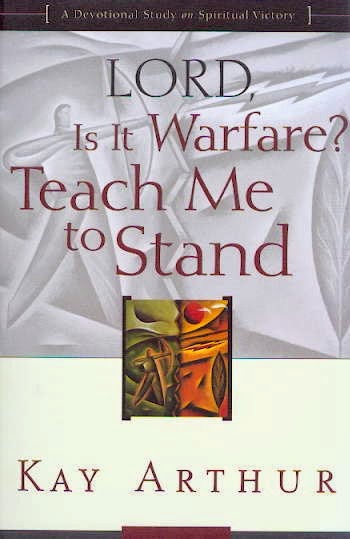
Lord, Is It Warfare? Week 4, Day 1
I would like to offer a bit of explanation for my
two-week layoff from writing. On early
Tuesday, April 15, my mother-in-law passed on to her eternal reward. I have literally known her my entire life as
my parents moved to Dothan when I was two and we started going to church here
in Dothan. My father-in-law had started
the church a little over a year prior to our arrival. In that little home missions setting the Lord
was at work but also His grace was at work in my own life too. I married Teresa, the Patterson’s oldest
daughter, in August ’86 and my life was entwined even more in the Patterson
family. My mother-in-law was diagnosed
with cancer about four years ago and despite surgery it came back with a vengeance
in January 2013. A little over two weeks
ago, her condition rapidly deteriorated and she required around the clock
care. I preached her funeral this past Friday and it was one of the most challenging ones that I have had to do. However, it has made heaven all the more real
to me and her illness caused me to dig into the Word and really look at what it has to say about heaven and where saints go
when they pass from this life. I would
tell you this, I have done a great disservice to myself and to our church for
not preaching more about heaven and the resurrection. I specifically did something special when I
realized that her condition was not going to improve outside of a miracle, I
got a leather-bound journal and started writing in it massive amounts of
Scripture on what heaven was to be like.
There are old hymns that have fallen out of our worship services that I
wrote in that journal. Furthermore, I
read sermons from the old masters of the past and found that they preached
about heaven from a whole different angle than what is preached today. Suffice it to say this. . . you must make it to heaven!!!!! No matter the cost, it has to be a
priority in your life.
Monday, April 07, 2014
Lord, Is It Warfare? Week 3, Day 5

I want to pick up with the Week 3, Day 5 portion before
moving to Week 4, Day 1 for tomorrow. I
got behind a bit last week but I really did not want to omit Day 5 because of
some of the content that I ran across as I was journaling through it. I will not add Day 6 or Day 7 because it is
primarily the summary of the previous material in the week with a host of
Scriptures that are designed to bring out various descriptions of the
devil. The following is pretty much the
exact content of my ramblings in my journal. . . with a fountain pen J. Specifically a TWSBI 580 medium nib loaded with
Pelikan 4001 Turquoise ink J.
-Note that the people who are involved in the spiritual
war are saints. The devil has no need to
attack those who are already in his kingdom.
If you sometimes have a tendency to think that evil-doers have an easier
path, the Bible very clearly articulates this in Psalm 37 and 73. Those psalms both have the same theme. . .
the prosperity of the wicked. On the
other hand, never think for a moment that they are never without troubles,
difficulties, and huge battles with their conscience.
Friday, April 04, 2014
Lord, Is It Warfare? Week 3, Day 4

Starting out with a great apology, I had fully intended
to work through this segment last week.
I know that some of you are following along with your own copy of Lord, Is It Warfare? and your journal
and you have been reading some of my thoughts in addition to what you are
doing. I apologize for not getting on
with this last week but I had some time pressures that sort of knocked me off
of my routine. The next thing that I
thought about doing was moving on to the next week in this series but there
were some things in Week 3 that I felt like would be important and I did not
want to omit them from the series. I
will certainly do my best to get back on track in the next few days.
Beginning with Week 3, Day 4 there are a lot of
recommendations concerning working through your Bible with a fair amount of
passages. As I worked through some of
those passages, I was troubled by them and that is the reason that I did not
just skip to Week 4 because I wanted to address my own troubles in a Scriptural
and honest way in the way that we
often view God. Job 2 has a tendency to
rattle some of our Americanized ideas about the identity of God and how He may
operate in our lives. Again what follows
are the exact notes that I have in my own personal journal.
Friday, March 14, 2014
Lord, Is It Warfare? Week 2, Day 5

Week 2, Day 5 of Lord,
Is It Warfare? opens up a huge and somewhat muddy theological answer that
has been debated and argued for a long time perhaps even centuries. The looming question is ‘did God create evil?’ Did he create the devil purposely to trip us
up? Did the devil have a free-will as
man did? Those types of questions can
fit into the place that Paul told Timothy to avoid. He told him that there are questions that
simply create and “gender strifes” (2 Tim. 2:23) and he told him to avoid those
kinds of things. It has been my experience
that oftentimes some of the foolishness in the name of “academics” that goes on
in seminary classrooms do not strengthen faith in the Word or confidence in God. So this is one of those sorts of
questions. I am aware of one thing in
this matter; I have been filled with the Spirit. . . It empowers me. . . but I
have an enemy who wants to destroy me!
That is the fact and there will be a struggle between good and evil
until God intervenes.
From the Scriptural passages the devotional brings out,
it is noted in John 1:1-3, Nehemiah 9:5-6, and Colossians 1:15-16 that all
things were created by God. I made a
connection by reading a little further over in John 3 that men choose darkness
rather than light because their deeds are evil.
Therefore I would come to a conclusion that at some point apparently the
devil possessed a will that moved him toward the trap of pride and he attempted
to exalt himself against God.
The lesson that I need to take away from this would be
the fact that I must live out Romans 6 and fight against the tendency for pride
to consume me. The only way to
effectively live above and beyond this is for my life to have a complete
dependence on the Spirit and walk out Romans 8 so that my mind is Spirit-filled
and Spirit-led. Pride in the heart of
the devil is what led to him being expelled from heaven. Remember that Jesus said it is not what is on
the outside that soils a man’s life but rather the things that are stored in
his heart (Mark 7:20-23).
Tuesday, March 11, 2014
Lord, Is It Warfare? Week 2, Day 2 & A Short Rabbit Trail

This study guide, devotional Lord, Is It Warfare? has been designed in such a way that we are
asked questions that aren’t leading but rather to help us to get to an
understanding of what the Bible has to say about spiritual warfare. Years ago, I can remember a writer, whom I
have long forgotten, giving the advice that we are to interrogate the text when
we are studying Scripture. This is a very
effective way to gain more than just a superficial knowledge of Scripture. If you can recall the old description of an
adverb, it is a word that describes who, what, when, where, and to what extent. Those are useful questions to ask when you
are looking at the Bible.
When we take a first look at the enemy, who is deceptive,
deadly, and intent on destroying everyone who is in allegiance with Jesus
Christ, we find him in Genesis 3. A
couple of other OT chapters also give a description of him. There is the brief allusion that Isaiah makes
in Isaiah 14 and there is a bit longer region in Ezekiel 28. It is a passage that has reference to the
king of Tyre but many biblical scholars also hold that imagery used by Ezekiel
would fit the bill for the devil also.
What causes us to come to this view is because of the words that the
prophet uses would in no way entirely describe a man. While there are some descriptions that would
fit a human king, there are also words that help us to see that the devil would
qualify in this description also.
Monday, March 10, 2014
Lord, Is It Warfare? Week 2, Day 1

I am going into the second week of the study guide/devotional
by Kay Arthur, Lord, Is It Warfare? Today we come at the concept of spiritual
warfare with a bit of a different angle.
The first emphasis that should garner our attention is Jesus
Christ. All spiritual warfare must began
with the understanding that the devil has been defeated at Calvary and through
the work of the Cross. The enemy has
been defeated at the present moment, he has been allowed to operate on the
earth until his appointed time of judgment.
Since one of the primary themes of Ephesians deals with this matter of
spiritual warfare, it is clear that Paul came to some conclusions when he wrote
Ephesians 1:15-23, in fact there are three truths to understand:
1. 1:18—There is a hope to which we have
been called. That hope helps us to
understand that there is a point in the future of which we will have rest from
the attack of the enemy.
2. 1:18—The riches of this inheritance or
position has been given to us and is clear through the work of the Holy
Spirit.
3. 1:19—There is an immeasurable power
given to the saint of God through the resurrection.
Jesus Christ is in a heavenly place. He has all power, authority, dominion, and
rule over the dark world of evil.
However, if this is the case then why is there a conflict that a
born-again man has to contend with? If
the Lord has all the power in the in this world and the one we cannot see, then
why the seeming triumph of evil right now?
Those are valid questions to consider.
These questions fall into a category called theodicy which basically is
an understanding of why God allows evil to exist in our world. Volumes and volumes have been written on this
subject and there is no way to give an explanation in this very brief blog
post. It is perhaps a rabbit trail for
another day.
Friday, March 07, 2014
Lord, Is It Warfare? Week 1, Days 4 & 5

One of the things that this study guide, Lord, Is It Warfare? works toward is
getting our minds to think in a biblical direction about spiritual
warfare. One of the benefits of this is
that it will move your mind to areas of Scripture and characters that exemplify
the principles. Day 4 and Day 5 are both
relatively short although is some more interaction with Scripture that is
necessary. By virtue of this, you make a
strong connection between the events of Acts 19 and the principles that are
expressed in Ephesians 6. One thing that
comes to mind is the closing out of Ephesians 5 and beginning of Ephesians 6
where Paul speaks of marriage and the family.
The reality of the matter of it all is that these too can be
battlegrounds that the enemy will attempt to insert himself into. While spiritual warfare takes place in the
heavens, it is played out in a very practical setting where we live our
lives.
Ephesus, because of occultic influence, was a place that
was driven by fear. The shamans, pagan
priests, and others given to the influence of the “curious arts” (defined as
such in Acts 19) played and preyed on the fears of the people. This caused me to consider the aspects of
America culture where that we pay money
to experience fear. However, I would cause
you to think in this way with me. If the
enemy can cause fear and use themes that have ominous spiritual outcomes to be confined to a movie screen, the viewer’s
compartmentalize it and believe that there is nothing to it. What a brilliant move but very deadly move by
the enemy. Kay Arthur notes, “Films, TV,
and recorded music evidence increasing control from the ‘dark side.’ Occult images fill even children’s films,
cartoons, and video games.”
Wednesday, March 05, 2014
Lord, Is It Warfare? Week 1, Day 3

We are to Day 3, in the first week of Kay Arthur’s Lord, Is It Warfare? study guide. You need fair warning to know that this entry
today will force you to think through some matters that are facing our society
today. One of the spiritual battles that
we face on a regular basis is when a there is a developing fearfulness of
speaking about these things and how that you will be perceived among your
friends. It is very interesting the
subtle peer pressure that is prevalent in the church these days both among
ministers and members when we speak something that is solidly Word-based that
is opposed to a humanistic bent. Say
what you will but this is spiritual warfare!
The same spirit pushing on Jehudi to take a penknife to Jeremiah’s words
in the Old Testament (Jeremiah 36:23) wants to do the very same thing
today.
To combat this and other attacks, Paul gave us some
instructions:
·
Be strong in the Lord—v. 10
·
Put on the whole armor of God—v. 11
·
Take the whole armor—v. 13
·
Stand—v. 13
·
Stand—v. 14
·
Put on the belt of Truth—v. 14
·
Have the breastplate of holiness/righteousness
in place—v. 14
·
Put the shoes of the Gospel on your feet—v. 15
·
Take the shield of faith—v. 16
·
Take the helmet of salvation—v. 17
·
Take the Sword of the Spirit, the Word—v. 17
The following format is the manner that I have recorded
these notes in my journal. It does not
follow an active paragraph style.
Tuesday, March 04, 2014
Lord, Is It Warfare? Week 1, Day 2

I am continuing from yesterday as we go through the devotional
study guide (study guide is a serious
understatement) by Kay Arthur, Lord Is It
Warfare? I am in much encouragement
of you working with this book and a handwritten journal. At the end of this, I am certain that you
will feel a sense of accomplishment but even more than that you are going to
have developed a sense of understanding of what Scripture has to say about the matter
of spiritual warfare. Furthermore for
those who serve in churches as Sunday School teachers, Bible study group
leaders, and even pastors, you are going to find a wealth of material that will
come to you at the right time as you are teaching.
One quick note of explanation for those who are not
familiar with some of the Greek language that the New Testament was written in. On yesterday’s post you would have noticed
that after the words for flesh, lust, and war from 1 Peter 2:11 in yesterday’s
blog there was a “G” followed by a number.
This is the system that was developed in the original Strong’s
Exhaustive Concordance used by Bible scholars, preachers, and teachers who did
not have a background in the Greek language.
Instead of having to know the language, the student could work with the number
system.
Monday, March 03, 2014
Lord, Is It Warfare? Week 1, Day 1

One of the top ten books for me in the honorable mention category from last year was KayArthur’s book, Lord, Is It Warfare? I did use it in some of my own personal
devotions but as I worked through it, I discovered that as a pastor, this book
was a launching pad of sorts to go beyond the exercises that had been given in
the book. Therefore, over the next
several weeks, I have intentions of putting some of my scribblings from the
book margins and from my own personal journals that I composed. Obviously the study guide has some areas of
personal reflection and evaluation that I will leave out for understandable
reasons. I would encourage you if you
are a regular reader of this blog to take some time to consider what will be
covered. Also I would greatly encourage
you to get the book, get a journal, and get a pen and write. For me, it ended up being about an hour time
allotment but it will become one of the most eye-opening hours that you will
spend during that day.
Spiritual warfare can be a slippery path that can lean
toward fanaticism or formalism. At the
end of the day what we must take into
consideration is what Scripture clearly and accurately addresses in this
area. If you have been in Pentecostal
circles for any length of time, you have probably heard some very fanciful
stories relating to this subject. I am
in that camp! I have heard some of the
most far-fetched stories that as the years have rolled on, I have dismissed
them as pure imagination of the teller who had a motive of self-aggrandizement
mixed with too much exposure to Hollywood.
On the other hand, because my father-in-law has been a district global
missions director for over 30 years, my exposure to missionaries has probably
been much higher than that of the average pastor. Friends, neighbors and all ya’ll in between,
when a missionary comes to town, the vast majority of them can tell you some
very clear and accurate things concerning the dark side of the spiritual
battle. I would encourage you to spend
time with these men and women and listen to
what they have to say.
Friday, January 17, 2014
Top Ten Books of 2013 - #1 - Standing Firm Through the Great Apostasy - Steve Gallagher

I come to this last best book slot, being #1, of the
books I read in 2013 and have found again it to be a very provoking book. I have gone back and scanned through and
reviewed much of what I wrote in it back in January 2013. I purchased the book in December 2012 primarily
on author recognition. I read a previous
book by Steve Gallagher entitled Intoxicatedwith Babylon and found it to be a very good book. I guessed that would have a pretty good idea
of the content that Gallagher would take up with this book Standing Firm Through the Great Apostasy. This is another book that falls into the
category of our personal need for revival and a reawakening of the church to
its true purpose. As I mentioned in a
previous post, books on revival and a true need for true repentance and godly
conversion was what I spent the most time with last year.
As a pastor, I often have to deal with very ambivalent
emotions concerning the state of the church both locally and nationally. There are times that I feel the great lift of
faith to believe that there is an ardent devotion to the Lord and to His Word
among those who follow the Lord. There
are other times when I find myself going into a tailspin at the shallow,
uncommitted state that we slop around in.
Perhaps nothing like social media reveals the true nature and direction
of where and what we are heading toward.
Jesus noted that out of the abundance of the heart the mouth speaks and
I think with our modern technological wizardry that now we can discover that
the abundance of the heart is revealed through what the keyboard types, what the
tweets reveal, and what the Instagram pics expose. All of this social media exposure can be terribly
disheartening when you began to understand the relentless onslaught of the
world, the flesh, and the devil on the church. Visit the profile pages of those who populate
Facebook and you see many people who are so immersed in the entertainment
venues of Hollywood, the music of Nashville, the insatiable appetite for the
fads of Fifth Avenue, and all sorts of troubling distractions that you wonder
if there is any hunger for God at all.
Some of what Gallagher addresses in the book relates to this.
Wednesday, January 15, 2014
Top Ten Books of 2013 - #2 - The Church Awakening - Charles Swindoll
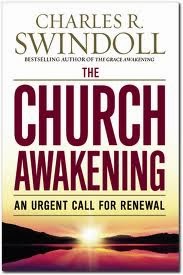
We are at the number two spot in my book reviews of the
best books that I read in 2013. This
book is one that published in 2010 and I got around to working with it in
2013. Chuck Swindoll has been around for
a long time and the majority of his books are primarily devotional in nature
and it is rare that he would take on a subject like this concerning the need
for revival in the church.
I noticed something about my reading patterns in 2013 and
that they were mostly concerned with personal revival and corporate revival
among the church. Anyone who is involved
in ministry has to understand the reality that when a church is in a state of
revival and devotion that things in churches go much smoother. Churches that aren’t experiencing a climate
of revival often turn inward and over the course of time will ultimately
die. We cannot afford for the local
church to collapse even though it is under a very heavy attack both socially
and spiritually in our day. On the other
hand, it is clear that when a church has well-defined boundaries and encourages
its members to have a high input that the Lord can do great things with
it.
Author: Charles Swindoll
Publisher: Faith Words, 2010
Tuesday, January 14, 2014
Top Ten Books of 2013--#3 - A Call To Spiritual Reformation - D. A. Carson
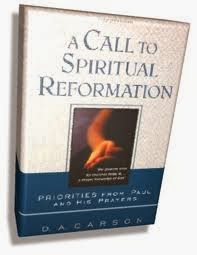
I am continuing to count down the best books that I read
in 2013 and now approach the third place.
This book could have very easily been tied for the 2nd place
but we will put it in this slot. I
noticed something about my reading trends in 2013 and that mostly I read things
about revival and spiritual renewal.
That was not my plan to get necessarily do so, it just sort of unfolded
in that way. This book by D. A. Carson
is an older book having been published in 1992.
However except for a few dated references that Carson makes to the ’80’s
and ‘90’s its message is still just as relevant now as it was then.
Author: D. A. Carson
Publisher: Baker Book House, 1992
Subscribe to:
Posts (Atom)
I Preached Another Man's Sermon
Yesterday (4/26/26), I preached another man’s sermon! Last week, my good friend, Pastor Jason Calhoun told me about a sermon that Pastor Na...

-
 Over the last several posts, I have tried to analyze some of the characters of Pilgrim’s Progress that was written by John Bunyan in 167...
 -
 Returning to John Bunyan’s Pilgrim’s Progress , I want to look at another one of his characters. This book over the years has been one I...
 -
 There are aspects of John Bunyan’s famous allegory Pilgrim’s Progress that have more details as you read on through the second portion of...